Mods tested on Minecraft 1.21.1
Sodium raised the frame rate 86% over terrain (304 to 564 FPS); it lowered the frame rate 31% with 300 mobs in view (103 to 71 FPS), because on Windows with an NVIDIA card Sodium turns on a driver workaround against crashes that makes each draw call wait, and this version draws mobs of mixed kinds in many small draw calls. On NeoForge 1.21.1 without the JVM argument that lets the NVIDIA driver recognise the game, Minecraft with no mods ran at 55 FPS with 300 mobs in view instead of 102.
Sodium mc1.21.1-0.8.13-fabric and Iris Shaders 1.8.14-beta.1+1.21.1-fabric loaded a world together on a client on Minecraft 1.21.1 in the Modkeel lab. 20 mod releases started in real Minecraft 1.21.1 games in the Modkeel lab, among them Sodium, Iris Shaders, Lithium, FerriteCore and Entity Culling. The Modkeel lab also ran 42 pairs of mods in the same game.
Lab data as of October 15, 2026. 20 releases ran, 42 pairs.
What the lab measured on 1.21.1
Frame rate on Minecraft 1.21.1 with each mod, against the same game without mods.
Sodium raised the frame rate 86% over terrain (304 to 564 FPS); it lowered the frame rate 31% with 300 mobs in view (103 to 71 FPS), because on Windows with an NVIDIA card Sodium turns on a driver workaround against crashes that makes each draw call wait, and this version draws mobs of mixed kinds in many small draw calls.
Iris Shaders, which runs on Sodium and had no shader pack loaded, raised the frame rate 76% with 300 mobs in view (103 to 181 FPS), 87% over terrain (304 to 569 FPS) and 103% with 300 mobs behind a wall (85 to 172 FPS).
Entity Culling raised the frame rate 129% with 300 mobs behind a wall (85 to 194 FPS).
ImmediatelyFast raised the frame rate 40% with 300 mobs in view (103 to 144 FPS) and 28% with 300 mobs behind a wall (85 to 109 FPS).
Lithium and More Culling did not change the frame rate with 300 mobs in view, over terrain or with 300 mobs behind a wall by more than runs without mods differed.
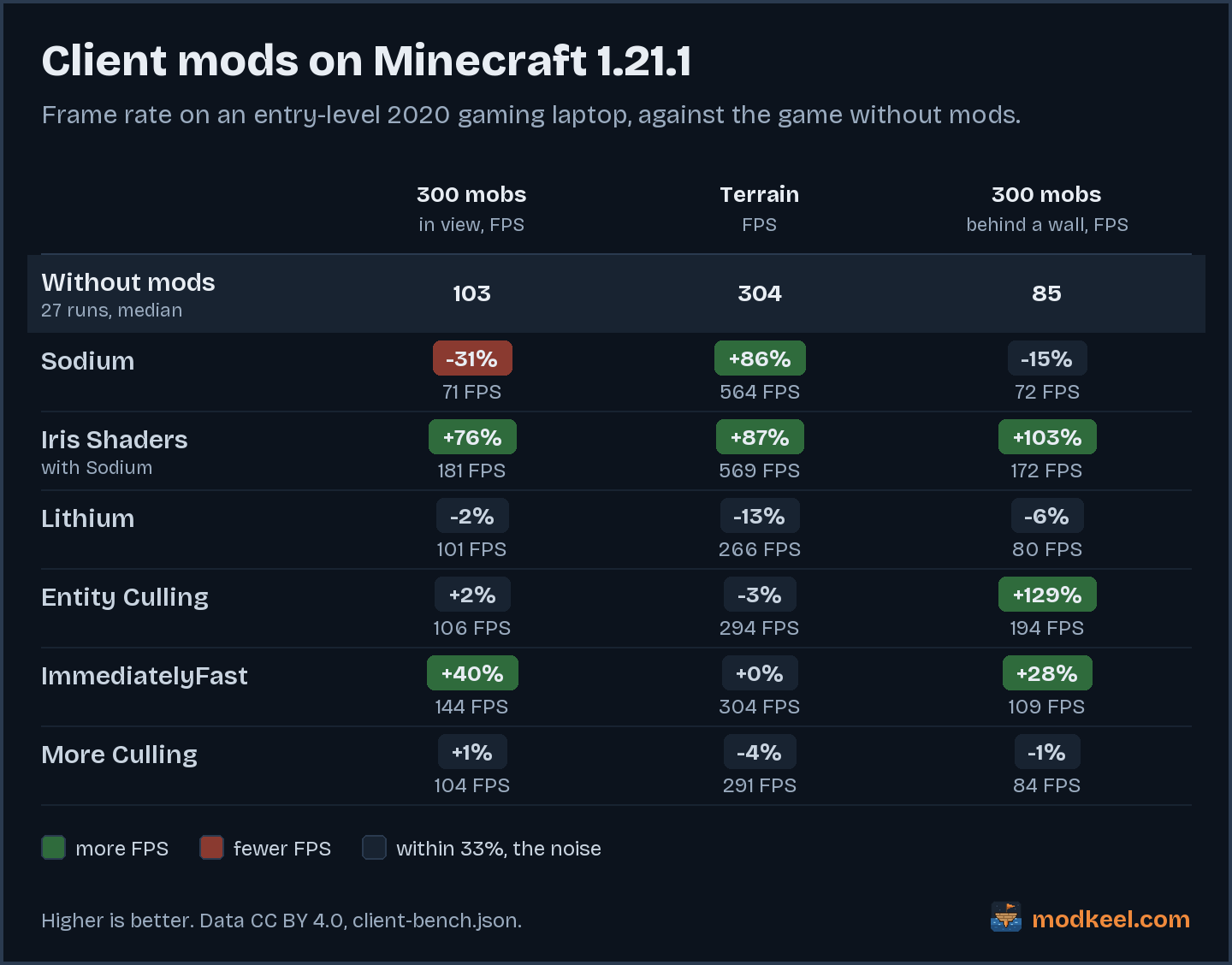
Measured on a laptop with a GeForce GTX 1650 and a Core i7-10750H, 2 to 27 runs per number; changes within 33%, the spread of runs without mods, are not counted. How the lab measures · raw data.
On NeoForge
These runs had the JVM argument --enable-native-access net.minecraft.client.main.Main, which lets the NVIDIA
driver recognise the game as Fabric does by itself (how to add
it). Without it, NeoForge 1.21.1 without mods ran at 55 FPS with 300 mobs in view instead of 102.
Sodium raised the frame rate 82% over terrain (320 to 584 FPS); it lowered the frame rate 35% with 300 mobs in view (102 to 66 FPS).
Iris Shaders, which runs on Sodium and had no shader pack loaded, raised the frame rate 65% with 300 mobs in view (102 to 168 FPS), 68% over terrain (320 to 540 FPS) and 99% with 300 mobs behind a wall (82 to 163 FPS).
Entity Culling raised the frame rate 120% with 300 mobs behind a wall (82 to 180 FPS).
ImmediatelyFast raised the frame rate 19% with 300 mobs in view (102 to 122 FPS) and 21% with 300 mobs behind a wall (82 to 99 FPS).
Embeddium raised the frame rate 88% over terrain (320 to 602 FPS); it lowered the frame rate 31% with 300 mobs in view (102 to 70 FPS).
More Culling did not change the frame rate with 300 mobs in view, over terrain or with 300 mobs behind a wall by more than runs without mods differed.
How it was measured: as above, with a real NeoForge client, over 1 to 4 runs; changes within 33% are not counted. Raw data: every run's frame rate per second, Minecraft and loader versions, GPU and driver, loaded mods and the SHA-1 of each jar, which Modrinth matches to the exact release.
Releases that ran on 1.21.1
| Mod | Release | Result |
|---|---|---|
| Embeddium | 1.0.15+mc1.21.1 | Client benchmark |
| Entity Culling | 1.11.2 | Client benchmark |
| Entity Culling | 1.11.2 | Client benchmark |
| FerriteCore | 7.0.3-fabric | Server started |
| ImmediatelyFast | 1.6.14+1.21.1-fabric | Loaded a world |
| ImmediatelyFast | 1.6.14+1.21.1-neoforge | Client benchmark |
| Iris Shaders | 1.8.14-beta.1+1.21.1-fabric | Loaded a world |
| Iris Shaders | 1.8.14-beta.1+1.21.1-neoforge | Client benchmark |
| Krypton | 0.2.8 | Server started |
| LambDynamicLights - Dynamic Lights | 4.8.11+1.21.1 | Loaded a world |
| Lithium | mc1.21.1-0.15.4-fabric | Client benchmark |
| Mod Menu | 11.0.5 | Loaded a world |
| ModernFix | 5.25.1+mc1.21.1 | Server started |
| More Culling | 1.0.10 | Loaded a world |
| More Culling | 1.0.10 | Client benchmark |
| ScalableLux | 0.3.0-alpha.0.7+1.21.1 | Server started |
| Sodium | mc1.21.1-0.8.13-fabric | Loaded a world |
| Sodium | mc1.21.1-0.8.13-neoforge | Client benchmark |
| Sodium Extra | mc1.21.1-0.9.4+fabric | Loaded a world |
| Very Many Players (Fabric) | 0.2.0+beta.7.172+1.21.1 | Server started |
Mods that ran in the same game on 1.21.1
Each mod, and the mods the Modkeel lab ran in the same 1.21.1 game with it.
- Sodium
Iris Shaders, ImmediatelyFast, Mod Menu, LambDynamicLights - Dynamic Lights, More Culling, Sodium Extra
- Iris Shaders
Sodium, ImmediatelyFast, Mod Menu, LambDynamicLights - Dynamic Lights, More Culling, Sodium Extra
- Lithium
FerriteCore, Entity Culling, ModernFix, Krypton, ScalableLux, Very Many Players (Fabric)
- FerriteCore
Lithium, Entity Culling, ModernFix, Krypton, ScalableLux, Very Many Players (Fabric)
- Entity Culling
Lithium, FerriteCore, ModernFix, Krypton, ScalableLux, Very Many Players (Fabric)
- ModernFix
Lithium, FerriteCore, Entity Culling, Krypton, ScalableLux, Very Many Players (Fabric)
- ImmediatelyFast
Sodium, Iris Shaders, Mod Menu, LambDynamicLights - Dynamic Lights, More Culling, Sodium Extra
- Mod Menu
Sodium, Iris Shaders, ImmediatelyFast, LambDynamicLights - Dynamic Lights, More Culling, Sodium Extra
- Krypton
Lithium, FerriteCore, Entity Culling, ModernFix, ScalableLux, Very Many Players (Fabric)
- LambDynamicLights - Dynamic Lights
Sodium, Iris Shaders, ImmediatelyFast, Mod Menu, More Culling, Sodium Extra
- More Culling
Sodium, Iris Shaders, ImmediatelyFast, Mod Menu, LambDynamicLights - Dynamic Lights, Sodium Extra
- ScalableLux
Lithium, FerriteCore, Entity Culling, ModernFix, Krypton, Very Many Players (Fabric)
- Sodium Extra
Sodium, Iris Shaders, ImmediatelyFast, Mod Menu, LambDynamicLights - Dynamic Lights, More Culling
- Very Many Players (Fabric)
Lithium, FerriteCore, Entity Culling, ModernFix, Krypton, ScalableLux
Updating your pack to 1.21.1?
The Modkeel Companion, a free mod for Fabric and NeoForge, backs up each world first. Crashed already?
What each result means, and the licence: about the lab data.